Our Staff’s Favorite Summer Gear! Sep’s Picks.

Each week, we’ll be highlighting a few staff picks of our favorite gear around the store. After all, we don’t just sell great clothing and equipment here at Shep’s; we also buy our great clothing & gear and use it for our own outdoor adventures! This week, Sep wanted to share a few items he just can’t live without.

1. Patagonia Arbor Pack – This 26L is one of my favorite backpacks of all time. It’s cool retro styling combined with easy entry and a bulletproof build make it perfect for a day of hiking or a place to stash your books. Plus, because it doesn’t have any built in padding along the back, it’s easily packable and hugs my body like a glove when I’m out exploring the outdoors.

photo 2

2. Chinook Superlight Mummy 45 Bag – I have the older version of this bag, and it’s been a champ for years. This one have been upgraded with Insufil 1 making it lighter and warmer than it’s predecessor, costs a mere $49, and is one of the best 45° lightweight bags I’ve ever used for any money. These are a true bargain in the camping / hiking world for sure!

photo 1

3. Patagonia Wavefarer Engineered Board Shorts – I’m kind of a Patagonia junkie, and for good reason. As a company, they continue to push for environmental causes to keep our world clean and renewable. They haven’t lost sight of the fact that people buy their clothing to be used outdoors, in tough conditions, with the highest demand for performance. Their fit and quality is amazing, and pretty much everything they design looks great! I picked these board shorts up before a recent trip I took to Oregon with my wife, and I never wanted to take them off. These shorts are super comfortable and built to last for years.

photo 3


You can swing by our Downtown Wausau location to check out our full line of backpacks, sleeping bags, and swimwear for all your outdoor needs!

Try Before You Buy: Watersports Demos at Shep’s

HO Sports slalom water skis, knee boards, paddle boards and tow tubes plus Hyperlite wake surf and wakeboard. Get your Demo on!

Our winter ski demos are popular because it’s your chance to test out the latest and greatest performance skis before making a purchase. And now? Now you can do it in summer too! Our waterski and wakeboard demos are in & ready.  It’s the perfect chance to test new gear for your outing on your favorite Wisconsin lake.

For just $25 per day, you can ride the new goods. And if you make a purchase yet this summer, half of the money you spent on demos will be put toward your bill. Yes, we mean it!!  Use your “refund” when you purchase your new skis or board, PFDs, ropes or even Sun Bum Sunscreen.  You need them all for fun behind the boat and we’ll help you choose the best fit and features.  All you have to do is purchase before Labor Day.  Preview our awesome gear here.

What are you waiting for? Grab some demo gear and get in the boat!

Visit us in the store for details. As usual, you must be 18+ to demo, or have your parent/guardian with you.

You taught us well, Mom

We’re a first class outdoor specialty store, not a greeting card shop.  But, we know a good poem when we read one. And we’re all about value, so we like a good sale.  You taught us well, Mom.

How did you find the energy, Mom
To do all the things you did,
To be teacher, nurse and counselor
To me, when I was a kid.Screen Shot 2015-04-20 at 2.01.16 PM..

How did you do it all, Mom,
Be a chauffeur, cook and friend,
Yet find time to be a playmate,
I just can’t comprehend.
I see now it was love, Mom
That made you come whenever I’d call,
Your inexhaustible love, Mom
And I thank you for it all.

Life is great in Wausau, Wisconsin for lucky kids whose mom’s teach them how to ski, camp, paddle, do yoga, ice skate, waterski, bike, roller skate, play tennis, sing, read, cook, plant, paint, care for the environment and care for others.  We personally thank Dorothy, Carol, and all of our moms for all they do for us, and all they have taught us.  Happy Mother’s Day!

What gift will you choose for her?  To start, select from our huge inventory of Unknown-9 Unknown Unknown-1 Unknown-4 Unknown-10 Unknown-3 images Unknown-8 Unknown-5 Unknown Unknown-1 Unknown-6dresses, yoga gear, sportswear, sandals, trail shoes, handbags and more of what you love from these well loved brands.  Of course we have awesome bikes, day packs, water skis, tennis and winter sports gear she loves too.  Love ya mom!


Unknown-2 images-1 Unknown-7Unknown-5

Successful cyclists adopt these smart habits

We like these summaries from our friends at Diamondback bikes and bicyclesafe.com. Keep yourself safe out there and reap the benefits of a two-wheeled commute.


Avoid busy streets.

One of the biggest mistakes that people make when they start biking is to take the exact same routes they used when they were driving.  It’s usually better to take different streets with fewer and slower cars.  Sure, cyclists have a right to the road, but that’s a small consolation when you’re dead.  Consider how far you can take this strategy:  If you learn your routes well, you’ll find that in many cities you can travel through neighborhoods to get to most places, only crossing the busiest streets rather than traveling on them.

Light up.

Too obvious?  Well, if it’s so obvious, then why do most night-time cyclists ride without lights?  Bike shops have rear red blinkies for $15 or less.  Headlights are just as important as rear lights.  And modern headlights use LED’s so the batteries last ten times longer than old-school headlights.
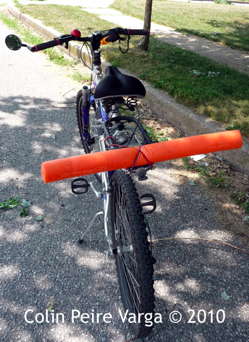

One cyclist tied this bright noodle to the back of his bike, exactly the width of his handlebars, to show drivers how much space he takes up on the road.

Take the whole lane when appropriate.

It’s often safer to take the whole lane, or at least ride a little bit to the left, rather than hug the right curb. Here’s why:

  • Cars at intersections ahead of you can see you better if you’re squarely in the road rather than on the extreme edge where you’re easily overlooked.
  • Taking the lane prevents cars from passing you too closely on narrow roadways.
  • Riding a bit to the left prevents you from being a victim of a door accident.

You might worry about slowing down the traffic behind you if you take the lane.  But if you’re on the kind of street where you’ve got cars blocked up behind you or constantly changing lanes to get around you, you’re probably on the wrong street and should find a quieter neighborhood street.

Taking the lane works especially well in most roundabouts.   The traffic generally moves slower so it’s easy to keep up, riding in the lane makes you more visible to motorists, and taking the lane prevents motorists from right-hooking you as they exit the circle.

It’s perfectly legal for you to take the lane when appropriate.  Most state laws say you have to ride as far to the right as is “practicable”.  Here are some things that make it impracticable to ride to the extreme right:

  1. You’re in a heavy traffic area with lots of side streets, parking lots, or driveways ahead and to your right.  Cars turning left won’t see you because they’re looking for traffic in themiddle of the road, not on the extreme edge of the road.  Move left.
  2. Cars are passing you too closely.  If the lane is too narrow for cars to pass you safely, then move left and take the whole lane.  Getting buzzed by cars is dangerous.
  3. Cars are parked on the right-hand side of the road.  If you ride too close to these you’re gonna get doored when someone gets out of their car.  Move left.

There are risks to both riding to the extreme right as well as taking the lane.  Whether you ride to the right or take the lane depends on the conditions of the roadway you’re on.  On wide roadways with few intersections/driveways, right further right.  On narrow roads with lots of intersections, ride farther to the left.   It’s not always better to take the lane or to hug the curb; it depends on the roadway you’re on.

Signal your turns.

You’re less likely to get hit when your movement doesn’t take motorists by surprise. Let them know you’re about to turn or move left or right by signalling with your arm. Point your left arm out to move left, and point your right arm out to move right. (You might have learned an old way of signaling a right turn with your left arm, but drivers have no idea what that means, so it’s useless. Signal a right turn with your right arm.) Before signaling left, be sure to check your mirror or look behind you before signaling (since a car passing too closely can take your arm out).

Re-think music players and mobile phones.

It’s more important to hear what’s around you when you’re biking than when you’re driving. Whether you want to ride with headphones is your choice, but doing so does increase your risk. Similarly, texting or talking with a mobile phone raises the risk level. When you’re mixing with car traffic, the fewer distractions the better. Also, you’ll want both hands free in case you have to brake suddenly.

Ride as if you were invisible.

It’s often helpful to ride in such a way that motorists won’t hit you even if they don’t see you. You’re not trying to be invisible, you’re trying to make it irrelevant whether cars see you or not. If you ride in such a way that a car has to see you to take action to avoid hitting you (e.g., by their slowing down or changing lanes), then that means they will definitely hit you if they don’t see you. But if you stay out of their way, then you won’t get hit even if they didn’t notice you were there.

On very fast roads cars have less time to see you because they’re approaching so fast. Of course, you should avoid fast roads in the first place if at all possible, unless there’s plenty of room for a car and a bike side by side. And if there IS such room, then on fast roadways, you can practice invisibility by riding to the extreme right. If you’re far enough right that you’re not in the part of the lane the cars are in, then they’ll zoom by and won’t hit you, even if they never saw you.

Here’s another example: It’s a good idea to signal a left turn, but it’s a better idea to make your left turn at a time or place where there aren’t cars behind you that could hit you while you’re stopped and waiting to make that turn. You can hang out in the middle of the street, stopped, with your left arm out, waiting to make your turn, but you’re counting on cars behind you to see you and stop. If they don’t see you, you’re in trouble.

Naturally we don’t advocate running red lights, but if you’re the kind of person who does, then apply the invisibility principle when deciding on whether to run a particular light: Could any cross traffic possibly hit me if I were invisible? If yes, then absolutely don’t do it. Never make a car have to slow down to avoid hitting you (red light or not). Remember, the more you rely on cars to see you to avoid hitting you, the more chances they’ll have to actually do so.

Remember, you’re not trying to BE invisible, you’re just riding with the assumption that cars can’t see you. Of course, you certainly want them to see you, and you should help them with that. That’s why you’ll wave to motorists whom you think might be about to pull out in front of you, and why you’ll be lit up like a Christmas tree at night (front and rear lights).

Remember that in many cases you’ll need to take the lane, in which case you’re counting on motorists to see you.

Pedaling along country roads warrants a specific set of safety considerations. As you roam rural lanes, keep the following in mind.

Don’t expect motorists to see you. In city traffic, dense streets and attentive drivers mean the key to safety is being assertive and using the rhythm of traffic to your advantage. But as your bicycle carries you away from town, the safer place to be becomes the side of the road. Likewise, plan to dodge cars in intersections even when you have the right-of-way.

Look behind you. Glance over your shoulder as you approach every driveway, intersection, and road hazard. Yes, every single one. A common car-on-bike incident is the right hook. This is when a car passes a cyclist, slows to turn right, and obliviously crosses the cyclist’s path on the edge of the street.

Watch for oncoming traffic. Passing motorists often accelerate into the opposite lane without looking for cyclists in their path. Similarly, I shudder to think about how frequently I make fast right turns onto two-lane roads without considering what might be might be fast approaching on the wrong side.

Avoid riding into the sunset. Riding into the sun makes you virtually invisible to motorists. If you’re stuck heading west at the end of the day, try taking a meandering route. And when the sun’s at your back, keep in mind that road users ahead will have difficult time seeing you.

Pause in high-visibility places. Whether you’re changing clothes, fixing a flat, or answering the call of nature, wait until you’re a safe distance from blind corners or hillcrests.

Don’t antagonize motorists. Sure, they might pass to closely, or worse. But on isolated roads, it’s best stay calm and let the incident roll off your back. It’s the only way to stay safe, have fun, and protect our image as cyclists.

“Deal of the Day” at Shepherd & Schaller Sporting Goods

Sometimes you just have to celebrate the little things.  Our “Deal of the Day” will make any day special and just a little brighter.  Treat yourself or give a gift, all month long.  Enjoy!

Water Bottles by Camel bak and Hydroflask.  Golf Discs by Innova and Discraft.  Packs and Bags from Prana, Kavu, Dakine, The North Face, Burton and more.

Screen Shot 2015-03-16 at 12.24.49 PM